Recommended reading: September 24th, 2018

Time for another edition of Recommended Reading! Most of this week’s posts are tips for moving overseas and raising kids abroad – with some lovely personal stories, too. But before I launch into this week’s round up, just a quick reminder: this is the LAST WEEK to apply for scholarships to attend the FIGT annual conference in Bangkok on April 26-28, 2019. It’s also the LAST WEEK to apply to speak at the conference! There are all sorts of presentations – speaking to large groups, sharing with small groups, coordinating a panel discussion, or even creating a poster. FIGT stands for Families in Global Transition and it is an amazing event and, even more than that, and amazing community. Read my post about why I’m excited about this event, or go to their website to apply for a scholarship or submit a speaking proposal. I’m going to be there, and I’ve applied to speak as well!

And now, on with this week’s Recommended Reading! The first two are about TCKs as young adults, and support for them on the journey. Since I’m currently working on a book for young adult TCKs, I lovelovelove reading this sort of stuff!

Third Culture Kids and the Growth Mindset
Life Story
Another great post from Rachel, with another helpful and hopeful idea for TCKs as they grow into adulthood. This one talks about growth mindset – the idea that we can continue to grow and learn skills throughout life, it’s not a case of either you have it or you don’t. Rachel points to a particular way that a false growth mindset like this can impact TCKs:
We can sometimes form this false growth mindset, believing that because our childhood primed us for adaptation and flexibility, that we are innately gifted at ‘fitting in’ or getting on with varied groups of people. In adulthood many TCKs experience isolation or a sense of ‘failure to adapt’, especially to settledness or host country communities. This experience jars painfully with the belief that they are ‘good at’ adapting and growing as individuals. It’s your classic double whammy – first it hurts that I feel socially isolated, second it hurts that this hurts! I should be good at this! After all, isn’t adapting what I’m all about? But there is hope! A true growth mindset is one that we can cultivate, at any time of life.”

Monday Morning Musings #10 – When You Know to Offer Them… Home
Monday Morning Emails
I love this piece, about expat parents of adult TCKs and the power of being able to offer them a home – somewhere. Also, this lovely paragraph about the power of the book Monday Morning Emails, which Jo and Terry Anne wrote together:
In Monday Morning Emails, Jo and I were honest about the challenges that our children have experienced. Often, the messages sent to us privately ask, ‘How are the ‘kids?’ In truth, they are young adults, and we both knew it was important to share their journey of depression/anxiety and struggles with identity. Why? With the hope it might help other families experiencing similar issues and as a parent, you are never truly at ease until your children are well.

Parenting Third Culture Kids: Identity & Belonging
The Premium Nomads
This is a great little post about TCKs, the confusion of place/belonging/identity, and a few helpful hints for parents. One of the main reasons I’m including it, however, is the following quote. It is one of the best descriptions I’ve come across as to why the Third Culture can be such a powerful place for TCKs:
Their experiences have been spread out between places across borders, and those places became connected to stories, life phases, friends in particular places, and their emotional connection to it all. Ultimately, they make up their own thread of life, laced with the pearls of their unique TCK memories, which they carry with them everywhere they go. And maybe that’s exactly where their belonging starts to manifest: the space where they meet others who carry the same beads, who have gone through the same experiences and with whom they feel a little bit more at home, because none of them really do, and paradoxically, that’s where home is.

Love ones left behind: understanding their emotions
The Home Wanderers
A poignant and powerful post about the other side – how our friends and family members may feel when we decide to move away from them. Far, far away. The author actually talked to her own best friend about this – about what the experience of being left was like, and advice she would give to expats and those who are planning to head out overseas.
Leaving your loved ones is one of the hardest things you will do and there are negative consequences of that action that affect not just you but the loved ones that stay behind. That person is happy with their life and having you nearby. By moving country, you are taking one of their comforts away from them and they feel powerless when faced with this unwanted change. Their resentment that ensues can therefore be frustrating and upsetting for the person moving away, however it is important to understand where they are coming from and treat them with kindness and consideration despite how negatively they react. Your friends and family ultimately want you to be happy and content.”

How to settle into life in Dar es Salaam from a family’s perspective
International School of Tanganyika
The story of one expatriate family’s transition. I really appreciated the two tips this mum shared for getting settled into a new location quickly – things I often advise myself! 1) make home cozy, a comfortable and homey place to retreat to; 2) get stuck into routine quickly. Also – this quote was an important one! Expectations of what a move will look like can really throw us:
Tanzania surprisingly took the longest time of all the countries I had moved to [to feel comfortable]. I think it was because I had expectations. The last time I had lived in Tanzania I was a teenager, now I arrived with a family, which was quite different.

Moving countries: why I am more with less
expat.com
Moving a lot really encourages you to pare down your *stuff* (especially if you don’t have a job package that includes packing and shipping services!) This post gives a few simple but really helpful hints of ways to divest yourself of belongings along the way. I really love that the first tip is “keep the unique and special”.
Souvenirs from my travels and memorabilia items such as a shell from a summer holiday, a pack of letters from my pen friend, a dried flower from my first love, are my weakness when it comes to my efforts for minimal living.”

Cross-cultural awareness: more than just a different country
FIDI
This post looks at three aspects of change and difference that impact expats: physical surroundings, specific cultural differences, and changes in self-perception. It’s not an in-depth post, but a good starting place especially for those considering a move abroad.
One thing you can be sure of? No two-week holiday – however authentic – can prepare you for working in another country. That would be like saying babysitting a few times prepares you for parenthood.

Tennis Star Naomi Osaka Perfectly Answers What It Means To Be Biracial
HipLatina
Finally, in response to current-ish events, here’s a post reflecting on Naomi Osaka, and her representation of biracial and cross-cultural identity.
This response is brilliant because in a semi sarcastic way, Osaka replied that while she is made up of all of these cultures, it doesn’t make her less Japanese or less Haitian or even less American nor does her identity have to be heightened in a way to create a storyline she has yet to write.

Recommended reading: September 17th, 2018

I read some great articles by TCKs over the (northern hemisphere) summer and decided I needed to do another TCK perspective special! There’s something special about hearing TCKs share their own experiences, in their own words. Although if you’ve read Misunderstood, chock-full as it is with TCKs telling their own stories, you won’t be surprised to hear me say that! So here is a selection of posts written by TCKs (or featuring interviews with TCKs) that cover a range of topics and experiences – including  belonging, grief, racism, and identity. And there’s a range of TCK voices – from countries including Cape Verde, Jordan, Mongolia, Pakistan, Philippines, South Korea, the UK, and the US. Enjoy!

A Missionary Kid’s Perspective
OMF
In a few short paragraphs, this missionary kid illustrates the tension and weariness of not fitting in – whether abroad or “at home”. The emotional burden of being rejected by peers and misunderstood by parents is captured perfectly. This particular individual eventually integrated these experiences and saw beauty in the parents’ choices, and followed them in their faith. This isn’t the case with all missionary kids. I still highly recommend reading this post, to get a sense of how it can feel for a child straddling expectations and struggling to fit in.
Did she really understand what was going on? I already spent most of the school day either being bullied or rejected, and so after school I stayed away from the other children when I could.

Opinion: It’s Okay to be Third Cultured Kids
The China Post
I really love this piece by a Korean TCK attending an American international school in Taiwan. The author shares the internal wrestling that goes on, trying to live and identify between languages and cultures. Any easy answers belie a deeper truth.
If being a “third culture kid (TCK)” was counted as a privilege, I’m certainly not idle, sitting quietly halfway. At the top, I’m proud of my multicultural identity, but below it, I’m confused, frustrated, and utterly in angst, of how loosely my identity is set in stone.”

My black community accuses you
TCK Town
I really appreciate this very honest piece, with the story of one TCK recognising the prejudices he was absorbing and living and then embarking on mindest change.
I ran into a huge problem when I moved back to my passport country, and I wasn’t prepared for how long it would take me to adjust. I got caught up in being racist. Over the next several years, I would need to train myself to not have averse feelings for my own race. I would need to learn not to discriminate simply because they did not speak or act like me.

Dear America, We’re Breaking Up
TCK Town
I decided to add another, more recent post from TCK Town. I really enjoyed Molly’s reflections on her sense of connection (and lack thereof) to her passport country.
I think the question “Where are you from?” will always elicit some anxiety and internal questioning. I’m not ashamed of being American, I’m just frustrated that I don’t feel like I belong here. Part of being a TCK is that we are forever searching for some sense of belonging. At least I am. I may not find that in one specific place, but I know I haven’t found that in America. Home means something different for everybody.

You Can’t Go Back
Kasama-Sama
A poignant and important message from an adult Missionary Kid. This might be difficult for some to hear, but it’s so important. There are great things that come with growing up overseas – but there are struggles, too. Pretending those struggles don’t exist, trying to only focus on the good, does a disservice to families.
When you belong to two places, you really belong to none. That is what they don’t tell you at the transition seminars. Why did I feel that I could not share this information with this missionary? The Christian community has by and large decided that MKs need to focus on the good parts of their experience- you know- all the adventures, and in the process it becomes taboo to talk about the trauma that comes along with growing up in two different cultures… When someone is not allowed to grieve properly they will engage in avoidance behavior. They will tell themselves they feel OK, or will try to bury their sad feelings. This is unhealthy!

The Boy Who Didn’t Cry Wolf
The Black Expat
Edgar first grew up in his father’s country (Cabo Verde) before moving to his mother’s country (Mongolia). This post shares some of his experience of living between countries and ethnicities.
When asked what is home to him, Edgar says that the idea of ‘home’ and ‘stability’ are not terms that apply to him the way they do to the rest of the world. Now living in the US, Edgar is fluent in Portuguese, Creole, Spanish and Mongolian – and of course, proud to be a very unique Cape-Verdean-Mongolian man.

Who are the burger kids?
Gulf News
A series of short vignettes from TCKs (from Pakistan, Philippines and Jordan) living in the UAE. They share some of the ways they are labelled as “other” when in their passport countries. This is portrayed as “good natured ribbing” and the TCKs being interviewed give it a lighthearted treatment, but I think it’s worth remembering that these experiences can also be painful – having your peers at “home” tell you so clearly that you do not belong.
I think growing up in culturally diverse cities and being immersed in all those different cultures forces you to be adaptable, and it teaches you tolerance and acceptance, knowing that there, literally, is a whole different world outside of your backyard…The challenge is knowing the word ‘home’, but not having a feeling to attach to the sound of it.

I Am a TCK, but Who Are We?
Noggy Boggy
This is a long read, but it gives a really good foundational explanation of what it means to be a TCK, written by a TCK. Aneurin covers the importance of culture, the TCK experience of belonging, the disconnect of being misunderstood by others, as well as building relationships nd cultural bridges. A long read, but very worthwhile.
If you haven’t experienced it for yourself, cultural differences can be all-encompassing. The surface level discrepancies are simple enough to identify, such as food or clothes. But there are much deeper and significant ones; perception of time, understanding of mathematics, or whether football or American ‘football’ is a better sport (seriously, there is only one winner here). Despite having a British passport, I am not British. I am a TCK. I belong to a cultural group which is not bound by time or place, but experience. It is unlike other groups and was once rare, but now has millions of people.

Recommended reading: September 10th, 2018

While I have plans for some more “themed” recommended reading roundups, the past two weeks there’s been so much going on (both inside my head and out!) I just haven’t had time to focus on it. Instead, here’s a bit of a hodgepodge of some good TCK/expat related posts I’ve read lately!

Culture & Identity
Expatriate Specialist
This piece by Chris O’Shaughnessy includes a fun story illustrating both the diffculty of being between cultures, and the advantage of being able to switch! He uses this to lead into reflections on culture and identity, and how fluid identity can be, especially under the influence of multiple cultural lenses.
Our identity is quite simply who we are… but it’s also who we’re not. In fact, the expat experience often highlights for us more of who we’re not than who we are… at least initially… I often think of identity as a zoom lens. By that I mean, I believe it’s a far more dynamic concept than people realize. If there were an incredibly powerful zoom lens on the moon and it zoomed in specifically on you – you would fill the frame. You are unique, and nobody is exactly like you if we zoom in that closely. Zoom out far enough though, and we could fit the whole planet in the frame. At this level, you are one of more than 7 billion other people, all on one planet. You have a lot in common on this level. I feel identity is a way of us deciding what different levels of zoom we’re going to concentrate on.

Expat life: expectation vs reality when family come to visit
The Expat Mummy
Oh, the gap between expectation and reality – something we all struggle with in different areas of life! This reminded me of my now husband’s first visit to Australia to see me when we were dating long distance. I wanted to show him the best of beautiful Sydney, to show him my beloved homeland. I wanted it to be a perfect trip for him. But then he got a really nasty cold and it RAINED nonstop which is so un-Sydney and then when started to feel better I got a migraine… Definitely not what either of us had planned, and yet, in its own way, perfect. Lying around on the couch watching TV and reading books together was actually kinda lovely.
The first hurdle was my own. My own expectations for what I wanted my family to experience their first time in Kenya was probably unrealistic. Grey skies and thunderous black clouds threatened to scupper my dreams of endless sunny days on white sand beaches. The rain never appeared and the skies cleared to perfection but my fretting at the weather was symptomatic of my feelings about the trip. I wanted everything to be perfect for the people I loved and worried too much that it wasn’t. My idea of perfection was unattainable but it didn’t stop me from wanting it…But in its own inimitable, frustrating, wonderful and utterly exhausting way, it was perfect.

10 things author Karien van Ditzhuijzen would like her readers to know about her
Female First
A little insight into the life of one TCK and expat author, including the motivation between the story of her recent novel. I really enjoyed this one! And I think I’d like to read her book, too…
When I moved to Singapore in 2012 I joined local NGO HOME that supports domestic workers. I wanted to learn more about what motivates women to leave their families behind to go overseas to take care of those of others. I learned so much about the difficulties they face; mental or physical abuse, no time off or getting their mobile phones confiscated. The brave women I met inspired the character of Aunty M, a domestic workers that joins a helpdesk helping many of her peers.

I Could NEVER Live Abroad
Taking Route
A lovely vignette, about that common comment – when someone hears about your expat life and says wow, good for you, but “I could never do that”.
Then I realize what’s really behind her words is fear. I think, She isn’t saying she couldn’t literally pack up her stuff and move abroad. She could, of course. What she’s telling me is this: She wouldn’t ever want to be challenged to live life so differently. She’s afraid. I get it. I don’t want to struggle to be understood, or try to find the new dentist’s office when I can’t read the street signs, or worry if my TCKs will ever look back and appreciate these experiences. I understand those fears, because I have them, too. I’ve just learned to operate despite them.

Hard Like a Peach or Soft Like a Coconut?
Velvet Ashes
Reflections from a woman who began believing her culture did things “right” and slowly learned to understand and even adapt in some ways to the culture she lives in.
When we moved overseas, I was a young mama strapped with loads of self-righteous opinions. Doesn’t everyone think their culture is the best and does things the right way? I’m sure we can all speak to the fact that actually, other countries and cultures do some things much better than our home culture.

Slaying It
I Am A Triangle
A fun piece about the cultural quagmire that is SLANG!! I am pretty fluent in Mandarin C‌hinese but I still get so tripped up on slang! It changes so quickly, and there’s no textbook to teach you. But when it’s your native language in your native land? Still a minefield!
We are a year and a half in to repatriation and still, I occasionally experience reverse culture shock. Having said that, I also realize that having pre-teenagers is a culture shock all on its own. Despite where you are living, there new words and abbreviations (and behaviors) to decipher… Perhaps learning to speak another language wasn’t so hard after all, I reflect, completely lost and exasperated in my native land…Some days, I would rather be back in German lessons instead of navigating the American-urban-landscape.

Schools for expat’s children in Gulf nations
The New Nation
A short article, but raising an important issue: providing education for the children of low-income expatriate workers. In this case, it is the possibilty of Bangladeshi schools in Gulf States such as Saudi Arabia, UAE, Qatar, Kuwait, Bahrain and Oman.

The World’s Best Bank Accounts for International Travelers and Nomads
Nomad Gate
Not my normal sort of recommendation, but I found this write up of international-friendly banks quite helpful! It has recommended options for Europe, UK, US and Australia/New Zealand.

Milestones! A celebration and a survey

Yesterday was a day of celebrating round numbers: the Misunderstood facebook page passed 1,000 page likes, and the survey of adult TCKs I’m running passed 100 completed responses! So for today’s blog post I’m going to share about both of those things.

First up – the 1,000 likes.

A bit under a month ago facebook sent me a notification about having passed 900 likes, and would I like to write a post to celebrate? Instead I decided 1,000 was a better number and set up a prize draw to celebrate when it happened. I wrote a post announcing this at the time. Yesterday, when the page got to ONE THOUSAND likes, I used a random number generator to pick a winner from the 25 people who entered. And the lucky winner was….

Helen! Helen just moved from the UK to the US with her family and is looking forward to learning more about the international world she is now raising her children in. She says she can’t believe she won; it was so fun for me to tell her the news! I’ll be posting her signed copy to her this week.

And next – the survey!

Two months ago I announced that I’ve started working toward a second book, this time for twenty-something TCKs – support for the journey from international childhood to independent adulthood. During the time in between I’ve had several conversations helping me clarify what I want to do, but mostly I’ve been working on a survey. I was stalling out on how to start my research, and finally realised what I needed was to do two separate surveys. I’d always planned to do a big and comprehensive survey to provide data for the book, but I realised I first needed some more foundational information to get me started, and give direction to interviews and the structure of writing.

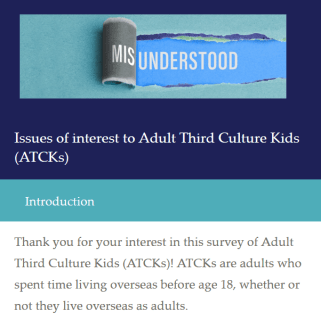
survey-imgI spent the last month or so creating and testing different versions of this survey (thank you to the 30 people who helped me test the drafts!) and last week I posted the final version online.

Most of the survey asks for reactions to different issues that twenty-something TCKs I’ve talked to and interviewed over the past few years have struggled with. The goal is to see which are the most widespread and deeply felt. There are also some optional open-ended questions, to catch what ATCKs feel is missing, and hear their advice for others. I’ve been blown away by some of the thoughtful and insightful comments that have already been left! Most comments reflect items already in my breakdown of themes and issues to covers, and have served as confirmation and additional layers on those. Some have raised additional issues I can see should also be included.

A few people have expressed concern that the list seems quite negative. I thought this was worth addressing publicly. The goal of the book is not to say that being a TCK is bad and ruins your life. I absolutely do not believe that! But I do recognise that life is rarely all good or all bad. There are huge positives to international life, but there are also difficulties. A big focus of my work in general is recognising those difficulties and providing support for working through them effectively so that TCKs can more freely enjoy the benefits of their experiences. I strongly believe that ignoring or covering over negative feelings/experiences is a mistake with long-term repercussions. A large focus of the book I’m working toward will be acknowledging that certain struggles exist, talking about how to face them and overcome them, and assuring ATCKs that they can (and will!) find a way through, and create lives they enjoy.

As I said, I have now received over 100 completed responses, and more than half of those have indicated a willingness to be interviewed individually for the book. I’m so encouraged by this level of support! My goal is to get responses from 300 ATCKs in their 20s, 200 in their 30s, and 100 in their 40s. I’m well on the way to that, although so far I have fewer responses from 30-somethings and from men generally, and I have a higher number of responses from the mission world. Hopefully as word continues to spread those demographics will even out a bit more.

And, because I’m a bit of a nerd, I’m going to finish this post with a little stastitics fun. Looking at the demographics of the completed responses, I can see that:

  • 27% currently have citizenship/PR in more than one country
  • 13% lived in 4 or more countries before age 18
  • 47% spent 10 or more years overseas before age 18
  • Combined, they have lived in 53 different countries before age 18
  • Combined, they span 26 passport countries, from all 6 passport-issuing continents:
    • Argentina, Australia, Bangladesh, Belgium, Bolivia, Canada, Chile, PR China, France, Germany, India, Indonesia, Japan, Kenya, Rep of Korea, Malaysia, Netherlands, New Zealand, Philippines, Singapore, Slovenia, Sri Lanka, Taiwan, Tanzania, UK, USA.

Will be fun to see how this changes and expands as more data comes in!

Update: click here for more recent (though still preliminary) results from the survey!

If you know anyone who spent at least a year living overseas before age 18, please pass this along to them! I would love to reach a wide range of people, from different parts of the world, with different international experiences.

You can take the survey (or just read the introduction to it) by clicking here.

Or scan this QR code to go straight there:

IMG_20180906_100210.JPG

Recommended reading: September 3rd, 2018

My latest collection of recommended posts about expatriate life and Third Culture Kids. This week includes topics such as transition, self care, identity, and ordinary expat life.

Dear Parents Launching Your Third Culture Kids
Djibouti Jones
A beautiful piece from the always lovely Rachel, this time describing the emotional storm of dropping her twin TCKs off at university – and leaving them there.
You feel alone. You look at the other parents, the ones who live in the same city or the same state or the same country and you are jealous or angry or feeling protective. You think no one understands all the questions and losses and griefs and fears racing through your mind and heart. You’re confused because no one told you raising TCKs would end up here, would end up with you on the other side of the ocean finally appreciating what you’ve put your own parents through all these years abroad. No one told you this would be harder than moving abroad in the first place.”

Never just a curry
Jo Parfitt
I love this! Food is so powerful – a memory trigger, a comfort, and so relational. In this post, Jo traces her family’s history of curry, across countries and continents – to the excitement of a new discovery.
For most of our 30 years of marriage, ask us what our favourite food is and we’d say Arabic without pausing for thought. But this week it hit me. It’s time we changed our answer – to Indian curry even though we have never lived there. I have not even visited. Curry has been a red thread through our lives abroad.

Football, Children, and Culture: Not Just a Game
Multicultural Kid Blogs
In this post a mother of TCKs talks about creating memories for her sons that connect them to the country that formed her, a country they have not lived in. A lovely read.
There are so many memories wrapped up in Watford football matches for me. And as I sit next to each of my sons on the terraces where those memories were made I am carefully unwrapping some of them and passing them to my sons for safe keeping. At the same time, my dad and I are making childhood memories for my sons – ones they will never forget. . . It’s hard for my children to imagine I had a life elsewhere before I ‘turned Dutch’. These trips are a small window into that life. They see the town I used to live in, they see a part of the life I had before I moved to the Netherlands and became their mother. They get a glimpse of the culture that has formed me, and them too.

6 Essential Practices for Hard-to-Reach Stressors
World Tree Coaching
Another great post from Jodi, this time exploring background stress and what we can do about it. This all rings very true for me at the moment! Life overseas pretty much IS background stress. There are so many little things that are different or difficult, so many small uncertanties and stressors, and they all add up. Background stress is one of those things we slowly adjust to until we’re drowning and don’t quite know why. The self reflection required to keep on top of this, to recognise the background stress of life in a different setting, takes a lot of conscious effort.
To deal with the challenges that hit at our egos, our values and our sense of purpose – it’s important to develop habits of self-reflection and insight. Taking the time to look more closely at who we are and how we fit in the world can be difficult. Sometimes the effort can feel daunting. We may not be sure we’ll like what we find there. On the other hand, deep down most of us know it’s important to do this type of inner work so that we can grow and develop into our full selves. One way to cultivate a more reflective state is to develop practices that naturally foster paying attention to our experiences. These skills can help us turn towards what’s going on inside and around us, giving us more information about the source of background stress.

Staying Healthy Overseas: Emotional and Mental Wellness
Taking Route
This is another good post in the same vein – looking after ourselves well enough to not only get through life but actually enjoy it, expat bumps and all.
It is easy to get burnt out while living overseas. I know that, you know that, but are we doing enough to make sure we don’t get burnt out? The answer for me is almost always “no.”…This article is not really a guide on how to do wellness overseas as much as it is a letter to myself to prioritize my emotional and mental wellness while living abroad.”

Redefining French Identity
The Parent Voice
This is a really interesting post – a story and reflections on identity, translated into English alongside the original French. Anissa talks about her experience of identity – two passports, from Canada and Tunisia, and being born in France but never having had French citizenship. She talks about the chameleon and the salamander as metaphors for changeable identity. For her the chameleon adapts by blending in, whereas the salamander cuts away pieces. She also talks about active vs passive – when I make the choice to adapt myself, rather than changing in response to the perceptions of others.

Simple pleasures: grocery shopping
Stories from Tanya
And finally, I’m sharing something from my other (more ordinary) blog, where I recently started writing again after a two year hiatus. I realised that this particular post is the sort of thing I would share as recommended reading if I read it elsewhere, so I figured I’d add it to the list this week! In it I deconstruct a trip to my local Chinese market, and why the experience was relaxing for me. It touches on transition, language, culture, and stopping to appreciate the lovely in ordinary life.
I don’t like standing out as a stranger, but I don’t mind so much when it happens less randomly. If I’m interacting with someone for a separate reason, and they remark on my foreign-ness and command of Mandarin, that doesn’t irritate me. Most of the time, I enjoy these little interactions. The person is not encroaching on my existence, they are sharing it for the moment that we are involved in a task together. . .I succeeded in being a local member of my community, for a few minutes on a sunny Monday morning.

Recommended reading: August 27th, 2018

My latest collection of recommended reading – recent blog posts about TCKs and expatriate life I appreciated and commend to you.

Goodbye 250
Communicating Across Boundaries
With the gracious writing I now associate with Marilyn, she says farewell to something ordinary. This is an important skill when it comes to leaving well. Recognising that the ordinary, the mundane, is what makes up our lives! Routines happen when I do the same thing over and over – which means those ordinary things take up a lot of time and space in my life, over time. They become my life. Familiarity can be a sweet thing indeed, and one worth savouring, and deliberately farewelling.
And today is my last work day. The last day that I sit in my cubicle, answer emails from my official email account, and answer the phone in my official capacity. Soon I will leave Boston and Cambridge. A plane will take me thousands of miles away to a small apartment on the other side of the world. I will leave a place I love to go to a place I have begun to love. Who is so fortunate? I ask myself this question every day. And when people ask me where I’m from, I will say with some pride, and no hesitation “I’m from Boston.” Those are sweet words indeed.

The Countdown to Good-bye
Raising TCKs
Lovely piece by a mother preparing to drop her son off at boarding school, and processing the fear and grief that goes with that.
For me my fear was losing my son to someone else. As soon as I wrote it out, peace broke through like a river (that song has never made sense to me until just now). And now I need to remind myself that I’m not losing my son. He’s just growing up. I can grieve that – but I also need to rejoice in the fact that he is growing up and becoming his own man.

Pardon Me, Can You Point Me to the Toilet?
Wine and Cheese (Doodles)
Great post about the differences of dialect – the different vocabulary we use in different English-speaking countries, in this case. More than that, how repeated exposure changes the way you speak, and eventually, the way you think. I’ve experienced this myself – so many words jumbled in my head, and I know one is the Australian and another the American but stuffed if I know which is which!
I think it’s because the auto-go-to for your brain alters. And not just for things like toilet vs. bathroom. It’s being overwhelmed in Target because of the sheer size and choice. It’s feeling strangled in the city of your heart because you’ve been outside of its embrace for too long. Its getting lost in places you should know, gone long enough that the breadcrumb trail has dried up and blown away, long enough that the muscle memory has atrophied and you panic you’re going need to use the GPS to find your way home.

Third Culture Kids and Safe Places: Community
Life Story
Another great piece in this series (though I’m late in sharing it!) Here Rachel talks through a bit of why community matters, why we struggle to build it, and how to move forward. She covers the importance of choice, and investment – as well as the need for intimacy, to know ourselves well and “being willing to share that self with others“.

How to Explain Work Travel to Your Child
Shanghai Mamas
Business trips are a common feature of expat life for many families. This is a good little article with tips for dealing with work travel and kids – how to explain it, say goodbye, and connect while away.

Adapting to Change Can Be HARD
Thrive Global
Great little post on dealing with change (transition) and a few simple tips to keep in mind when it’s hard. Very similar to what I’ve written about change and transition before, and how in a season of transition we lose our “automatics”.
If change happens so frequently, why is it so difficult? For one thing, humans are creatures of habit. Much of what we do daily – from putting on our clothes to driving a car – happens without us even thinking about it. Our brains don’t need to do a lot of work to carry out repetitive behaviors that have formed into habits – our unconscious brain takes over. But changing those routines is a different story. It requires focus and attention, and it makes our brain work overtime to adapt; we have to be intentional and make conscious choices.

Finding Fun on the Field
Velvet Ashes
Fun story about finding fun in a cross cultural setting! I’ll admit I’m still struggling to find the fun/relaxation in my latest home. So this is a good reminder to me – and I hope to others as well!
Fun is a short-term pleasure, with long-term effects. Maybe it’s reading a book in the hammock, or going out for a good coffee with a friend. It could be hosting a party, or walking along the beach at sunset. Having fun allows us to lift our eyes, even just for a moment, from the heavy toil we might be in and see a bigger picture.”

TCKs in the 21st Century

I recently had a guest post up on China Source, talking about TCKs in the 21st Century. I am often asked why my research (and book) focus on young TCKs. One angle is that of older TCKs, wondering why the new crowd get so many resoures while there is little available for older TCKs. Another question is about why there needs to be a focus on the 21st century specifically. Is there really any difference? In short – yes, there really is.

Here’s a summary of why I think it’s important to differentiate the experiences of 21st century TCKs from those of earlier generations:

“In researching the experience of living overseas as a child, I looked specifically at the experiences of TCKs born after 1985. These young people grew up under the influence of the internet and all the changes that have come with that. These younger TCKs were twice as likely to identify as having lived in an “expat bubble”, more likely to have attended an international school, and far less likely to have attended boarding school (10% as opposed to 50%). More importantly, changes to travel and communication over time have changed the emotional experience of TCKs.”

There are both pros and cons that come with improved communication and travel. I don’t know that the experience of TCKs in the 21st century is measurably better or worse than the experiences of those in years past. But I do think their experiences are measurably different.

For more on the topic, including a little of what I think those pros and cons are, see the full article on China Source: TCKs in the 21st Century

**

An updated version of the TCKs in the 21st Century post has been published on tanyacrossman.com

Recommended reading: August 20th, 2018

My latest collection of recommended posts about expatriate life and Third Culture Kids – this week blending stories of practicalities and emotions.

Sentimental means “settled” and I don’t like that
TCK Training
In this lovely little piece Lauren reflects on receiving inherited furniture – and realising that, for the first time in her life, she owns physical objects she can’t pack into a suitcase. That’s a big deal for an ATCK! She comes to a work-in-process conclusion:
“I am learning to be content rooting myself for a while. Learning to invest in friendships and to plant trees – both of which need time settled in one place to see grow. . .I am learning to value the sentimental- even when it doesn’t fit in my suitcase.”

Too stupid to order ice cream in the US?
Share the Love
I love this little piece about buying ice cream, and the differences between doing so in the US and Europe. It’s a great illustration of the sorts of little things that change when one moves. Simple things like ice cream require adjustment and understanding! The sheer number of things that require thought in a new place can be overwhelming (something I’ve written about before).

Life’s humble hunt – part 1
Life’s humble hunt – part 2
The Black Expat
This series of two posts tells the story of TCK Adrienne, as she met and married the untravelled Terek, and embarked on overseas adventures together – eventually adding the complication of an MS diagnosis, and now raising their own TCKs in Malawi. I particularly appreciated this observation, about the nature of childhood (not knowing anything else) and recognising different values in the culture around you.
Since our children are [young] they don’t know any different so they have nothing to compare it to. They don’t know what’s going on in the States or that they’re American. They’re really just free children. And I don’t know what to compare it to either, because they’re our only children and they were only eight months and twenty-one months when we moved. There are things we enjoy about being here that I think will help shape them into patient people. Our adrenaline rushes all the time as Americans. Or at least in my family. Here, the things that ordinarily would upset us, don’t upset someone. They just have a different type of calm. I’ve noticed that here in Africa. I’m hoping our children pick up on a lot of that.

The Guilt Of Distance
I Am A Triangle
Living abroad comes with many advantages, but there is also a price to pay (something I’ve written about before). This is a post that opens up feeling many expats would rather leave closed away – the guilt of being away from people we love. This post discusses the pain and guilt of seeing parents age, from a distance. It raises questions the author has no answers for – questions which perhaps don’t have answers, or at least not easy ones. Sometimes it’s helpful to just sit with these feelings, whether or not answers come.

I am peculiar here, might as well embrace it
A Life Overseas
I love this post, with its quirky stories of being the ‘peculiar’ foreigner in a remote village. I love author Anisha’s desire to blend in, to be part of the community, and also her pragmatic acceptance that this will never completely happen in her situation. It’s an important balance, I think.
I’d like to think I’ve got the hang of living here, but the reality is I probably truly understand about 20% of the cultural happenings around me. The society here is so complex, and I am so bizarre to them. . .Peculiarity is something I can embrace because it’s what I really am. Of course I am hopeful the longer I live here the more I’ll understand the intricacies of this culture. But why fool myself? Someone will probably always want to sneak a peek in my fridge.

‘What’s up with that white voice?’: The tricky art of linguistic code-switching
Chicago Tribune
This article looks at “code switching” – adjusting the way one speaks – from a minority culture to majority culture manner of speech. Code switching is something quite familiar to many TCKs. I have heard many stories of sub-conscious code switching, and of this creating conflict with others who don’t understand why this happens. An interesting piece to better understand why we change ourselves to match others, and the toll this takes.

Do writers need a nationality?
Elsewhere: A Journal of Place
This is a really interesting read. Author Vesna Main reflects on what it means to be identified by nationality. A review of her work labelled her with her country of birth, although she has lived elsewhere for 40 years and writes in a different language. Her musings on belonging, and belonging rooted in something other than place, are fascinating.
“So, what is it, I wondered, that is supposed to make me a Croatian writer? What is it that makes most people insist on a label of nationality? Is it simply a shorthand to enable communication? Or is it an expression of a belief that everyone ought to belong to a nation and that those who do not are somehow morally deficient and untrustworthy?. . .My fellow nationals are other writers, some published, some toiling in patient obscurity. I have chosen to belong with them. And if you ask me whether I miss this country of writers on the days when life intervenes, yes, absolutely, I do. I am ‘normal’, after all.”

Unrequited love of place

In a recent recommending reading post I linked to Mariam’s “break up letter” to Dubai, the city her family just moved on from. There were some things she wrote at the end of her letter that I found particularly poignant and worth some further reflection:

Dear Dubai, my bags are packed, my goodbyes are done. My memories are now strewn all over your glittering skyline. Your streets will forever feel like home, your parks and beaches are the background of my kid’s childhood photos. How many times over the past four years have I posted pictures of you and me together on Instagram and used the popular hashtag “#mydubai”? But then wondered, are you really mine? Can you ever truly be mine?

Today I wonder, why does it hurt so much to leave a city that was never mine to begin with?

Falling in love with you Dubai, is like falling in love with someone who says “I’m not looking for any commitment. Nothing serious, please.” Once an expat in Dubai, always an expat in Dubai, because there is no path to long-term citizenship in the UAE.

This is why I have to break up with you Dubai. Trust me, it’s for the best. I need to move on. Some relationships are short like yours and mine, but it doesn’t make them any less meaningful. Better to do this sooner rather than later, when it will hurt even more.

This captures beautifully the tension felt by many expatriates, and especially by many TCKs. Relationships are not unilateral. There is a two-way street. Can a place ever be truly mine unless it embraces me, too?

An immigrant is a person who has this two-way relationship with a country. They have chosen the country, and the country has chosen them. There is acceptance in both directions.

Expatriates do not have this.

An expatriate is someone without a long-term commitment. For some, it is because they do not want a long-term commitment. They want to go back ‘home’ after their time is done. For others, the country they live in does not want a long-term commitment. There is no path to citizenship, no way to legally become a local. This is where the “unrequited love” of the post title comes from. There are many expatriates around the world who have fallen in love with a country that will never fully embrace them.

That’s my situation, in China. I love this place, I really do. But I can never become Chinese. Not legally, and not in the eyes of Chinese people. I must live with the uncertainty of a constantly changing visa situation, and never having permission to remain more than one year at a time.

Many TCKs live with this. The place of childhood becomes inaccessible. There is no legal rights to belong. There is no recognition of their connection. The place they love, and were raised in, does not acknowledge them.

Perhaps a better relational analogy for the TCK experience is foster care. Temporary guardians, not permanent family. Some foster situations are joyful and warm, others are difficult and even traumatic. Some can lead to permanent adoptive situations; I’ve interviewed a number of TCKs who were able to gain citizenship in the country they grew up in as expatriates. But for many, that is not an option – even for those who wish it was.

There is a particular pain that goes with unrequited love of place. To feel at home in, identify with, love, a particular place – but have no security there. A place that says, as Mariam put it: “I’m not looking for any commitment. Nothing serious, please.”

Amy Medina wrote about this feeling in a post I included in a different recommended reading list. She called it “forbidden roots” – creating those connections in a place you know won’t be forever. She also used relational terminology to describe it, writing: “It’s like coming to the realization that I’ve fallen in love with something that I can’t keep.

It’s hard to keep giving yourself to a place that won’t ever love you back, so to speak. To invest in a place that won’t invest in you. Mariam wrote of the choice to leave, before it hurts too much. Amy wrote of the choice to invest, knowing it will hurt much.

But here’s the crunch for TCKs, again – the lack of choice. This unrequited love of place is the result of choices made on their behalf. But as with anyone, in any life situation, all we can do is choose how we respond to what life has brought us. We can choose where to invest ourselves, our lives, our love – in this moment, and from now on.

Click here to read my Lightning Session on our relationships with places, which expands on this idea.

erlizhuang.JPG

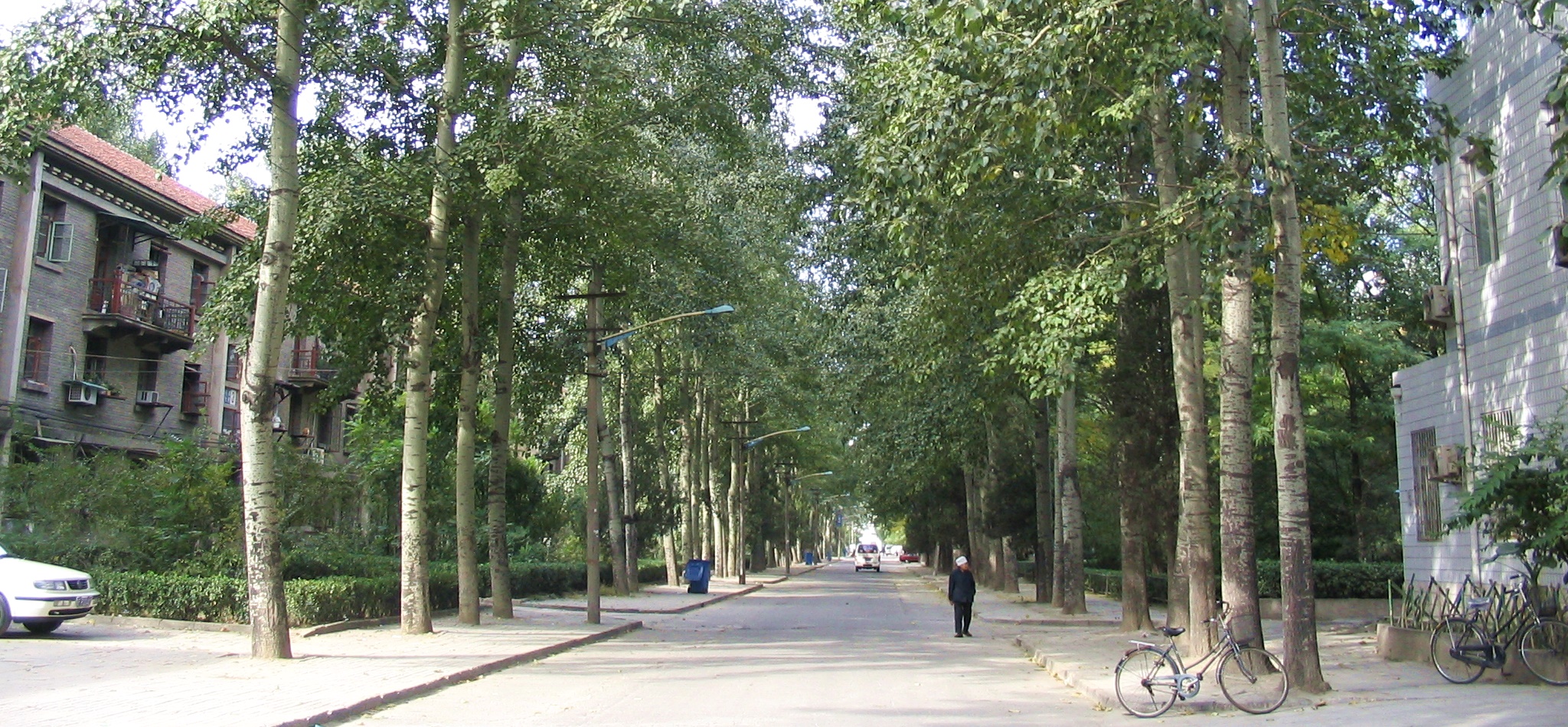
This quiet back road was part of my regular commute during my first year in Beijing (back in 2004).

Recommended reading: August 13th, 2018

This week’s recommended reading has an education focus. School is a huge part of any child’s life – and no less so for Third Culture Kids. Moving around the world into a new school – a new school system, with different expectations and perhaps even a different language – is a big challenge to overcome! It’s really important for those of us supporting and caring for TCKs (and their parents) to think about how education plays out in the lives of international families. This is a loose collection of recent articles discussing different elements of education – transition, language, culture, and alternative ways of learning.

Bilingualism and Homework, part 2
Expats since birth
This fantastic post was written by Ute Limacher-Riebold, who always has great tips for international families. She discusses something that comes up in a lot of international families: what to do when your children attend school in a language you aren’t fluent in? What is most valuable about this post, however, is the range of really great practical advice for parents in this situation. In particular, how to learn the language of study and exams, for both parents and students.
“What for a native speaker is “common sense” might not be for someone who speaks this language only at school (or at work for that matter…). Here are some sites where you can find an overview of recurrent terms that are used in English exams…”

How to cope with sending your child to a school that isn’t diverse
Multicultural Kid Blogs
This one isn’t about expat kids necessarily, but about parenting a child who is a minority in their school – something that can happen whether at home or abroad. There is great practical advice for parents here, on how to support a child through an experience that has the potential to be stressful.
When your kids are in school, one of the most important things you can do every day is to talk to them. Sometimes simply asking how their day went is not enough. When your child is attending a school that isn’t diverse, it’s important to make sure they are having a good experience.

4 Tips for a Stellar Start for International Children Starting a New School
Multicultural Kid Blogs
And now, by their powers combin: a post by Ute, published on Multicultural Kids! This piece has solid advice on ways to help kids transition into a new school in a new location. Includes a lot of reference links to additional material, too.
If we have been through this kind of change before, we tend to assume that they [children] will all be fine (in time). I strongly advise not to do that. . .what was easy before might be an issue now. During a transition, our children tend not to make us worry and would do anything to see us happy.

A Parents Guide to Changing Schools
Mixed Up Mama
This is about changing schools generally, but I found there was a lot in here that is valuable for international moves, too. From acknowledging the emotional difficulty for parents watching a child struggle with adjustment, to logistics. I particularly appreciated this piece of advice: “Consult with your children but don’t let them decide.” I talk to parents about this a lot in regards to the decision to move. It is great to consult your kids, but don’t pretend they’re really making the decision – you will decide whether to move or not, even if that decision is impacted by your child’s opinions. Be the parent, make the decision, and acknowledge to your child that that is the situation.
Some of the reasons we couldn’t always share with her as they were about things she may not have always understood- long term vision, bigger picture as a family etc. Children think in terms of the short term and their immediate situation. We did share with her slowly some of the reasons but left it open for her to see some of the advantages herself as well. We talked with her at every step of the process getting her ready but ultimately it was our decision as parents.

Why teachers shouldn’t be afraid of other languages being spoken in the classroom
The Conversation
Clare Cunningham discusses her research on alternative lanugages in the classroom, from the perspective of English-language education in the UK. She brings up several interesting points (and links to her research) about reasons teachers may prefer a monolingual classroom. One teacher “spoke about what she called “the inappropriateness of language” – claiming that children only use other languages when they want to be rude or exclude others.” This has certainly been an argument in some schools I’ve known who maintain an “English-only” school environment. A related argument is that allowing other languages excludes children who cannot participate in that language. Clare also notes promising changes as schools and teachers are “striving to overcome their worries about multilingual spaces and making excellent use of online resources for curriculum based work in a range of languages – as well as providing tailored teaching materials for children that need them.

Supporting Education From The Outside In
LinkedIn 
This fantastic article links the power of art and storytelling to fostering emotional wellness in cross-cultural children. This is something I wrote about in Misunderstood, and is something others have tackled as well. Author Michelle is Board President for Cultured Kid, an organisation working on curriculum that uses art and storytelling to support CCKs in their identity struggles while simultaneously developing greater cultural undestanding and empathy in their mono-cultural peers. I am really excited by this concept and hope to hear more about it in the future!
For the past year Cultured Kids has been working alongside education professionals, consultants, and students in public health and child development to tackle this single complex question: Is it possible to create a curriculum for schools that could support academic achievement in conjunction with promoting individual social emotional wellness within this sea of cultural complexity? We believe there is.

Why Worldschooling?
The Black Expat
Interesting perspective on alternative schooling. Worldschooling uses the world around us to direct amd encourage learning. Author Karen and her partner are both trained teachers, and have used their experience along with a worldschooling mindset to educate their son while travelling abroad.

What is worldschooling?
World School Family Summit
With my interest piqued, I went and found this recent article describing worldschooling a little more, including descriptions of different ways this works for different families. In this post, TCKs are considered worldschoolers even when they attend traditional schools (international or local) as they are still outside their ‘home’ culture and its educational system.

Expat education and separated parents
Expat Child
This is a short article, more of an overview, and is based in the UK system. That said, it raising several really important questions regarding co-parenting an education, especially when an international move is part of the equation. For example:
When a child attends school in another country there can be many decisions requiring a parent’s consent which can be difficult to obtain when the parents are abroad and more so if communications between separated parents are difficult.